After a raise, your bigger budget pays off only as fast as the loop between deciding to change something and getting it live. Spend and cycle time are complements, and they multiply. Starve one while you scale the other, and the new money buys less than your last dollar did.
Spending more is already producing less across B2B SaaS. In 2024 the median new-customer CAC ratio hit $2.00 of sales and marketing per $1 of new ARR, up 14% year over year. Over a similar window, the median sales-and-marketing revenue multiple slid from roughly 6x to roughly 3x.
A raise does not fix that math. It raises the stakes on an efficiency problem you already have. So the useful question is what the money actually buys.
The short version
- A raise changes what you can spend, not how fast you can learn. Budget sets how fast data arrives. Cycle time sets how fast you act on it.
- Bigger budgets find winners faster, but only inside a loop that can use the data. On a slow loop, extra spend funds the same untested bets at higher volume.
- Industry data shows the cost of a new customer climbing while sales-and-marketing efficiency falls. More spend without faster iteration compounds the problem.
- The distinction that matters is budget × cycle time, not budget then cycle time. They multiply.
- The binding constraint after a raise is usually organizational. Handoffs and approvals decide how many quality shots you get.
What a raise actually changes
The instinct after a raise is simple: more budget, more pipeline. A raise does change two things. It lifts the ceiling on what you can spend, and it resets what the board expects from growth.
It leaves the rest untouched. Your iteration cadence stays the same. Your conversion tracking stays the same. The number of days a change takes to reach a live campaign stays exactly where it was the week before the wire cleared.
The money will get deployed regardless. Equity-backed companies already spend about 100% more on marketing and about 70% more on sales than bootstrapped peers, with the median company putting 8% of ARR into marketing and 15% into selling costs. Raised capital finds its way into spend.
So the real question shifts. What matters now is how fast you can turn that spend into learning.
Budget sets the pace of data. Cycle time sets the pace of learning.
Budget is how quickly you accumulate signal. More spend means more clicks and more conversions per week. That part is real, and underfunding genuinely starves the loop.
Modern bidding needs volume before it can work. Google advises measuring Smart Bidding performance over periods with at least 30 conversions, and 50 for Target ROAS. Below that, the system is guessing and so are you. Budget buys you across that threshold.
Cycle time is a separate variable. It is how fast a piece of signal becomes a change in the account. Every handoff taxes it: waiting three days on a designer, or routing a copy edit through two approvers before an agency reviews it on Thursday.
With a raise, you usually fix the first constraint and ignore the second. You pour in enough budget to generate signal quickly, then let that signal sit in a queue. The data arrives fast. The response stays slow.
What breaks when spend scales but the loop doesn't
The learning phase stalls
New budget tends to spread across new campaigns. Conversions fragment, and none of the campaigns clears the volume it needs to learn. Google's own guidance is to minimize fluctuations while the bid strategy adjusts. Slow, batched edits on a large budget keep resetting the learning phase, so the system never stabilizes.
You buy more of the wrong signal
If your counted conversion is a content download or a form-start, a bigger budget buys more of it. The dashboard brightens while qualified pipeline stays flat. You are scaling low-intent volume and calling it growth, because the metric you optimize toward was never revenue.
Efficiency decays where you can see it
This is the shape the benchmarks describe. CAC payback periods are up 12.5% since 2022. Rising cost on rising spend is what budget outrunning cycle time looks like on a chart.
Each of these is the same root cause wearing a different costume. Spend arrives faster than the loop can test it and correct.
The distinction most people conflate
Many teams treat budget and iteration speed as a trade. The logic sounds reasonable after a raise: we do not need to move faster, we just need to spend more. That treats the two as substitutes, where more of one covers for less of the other.
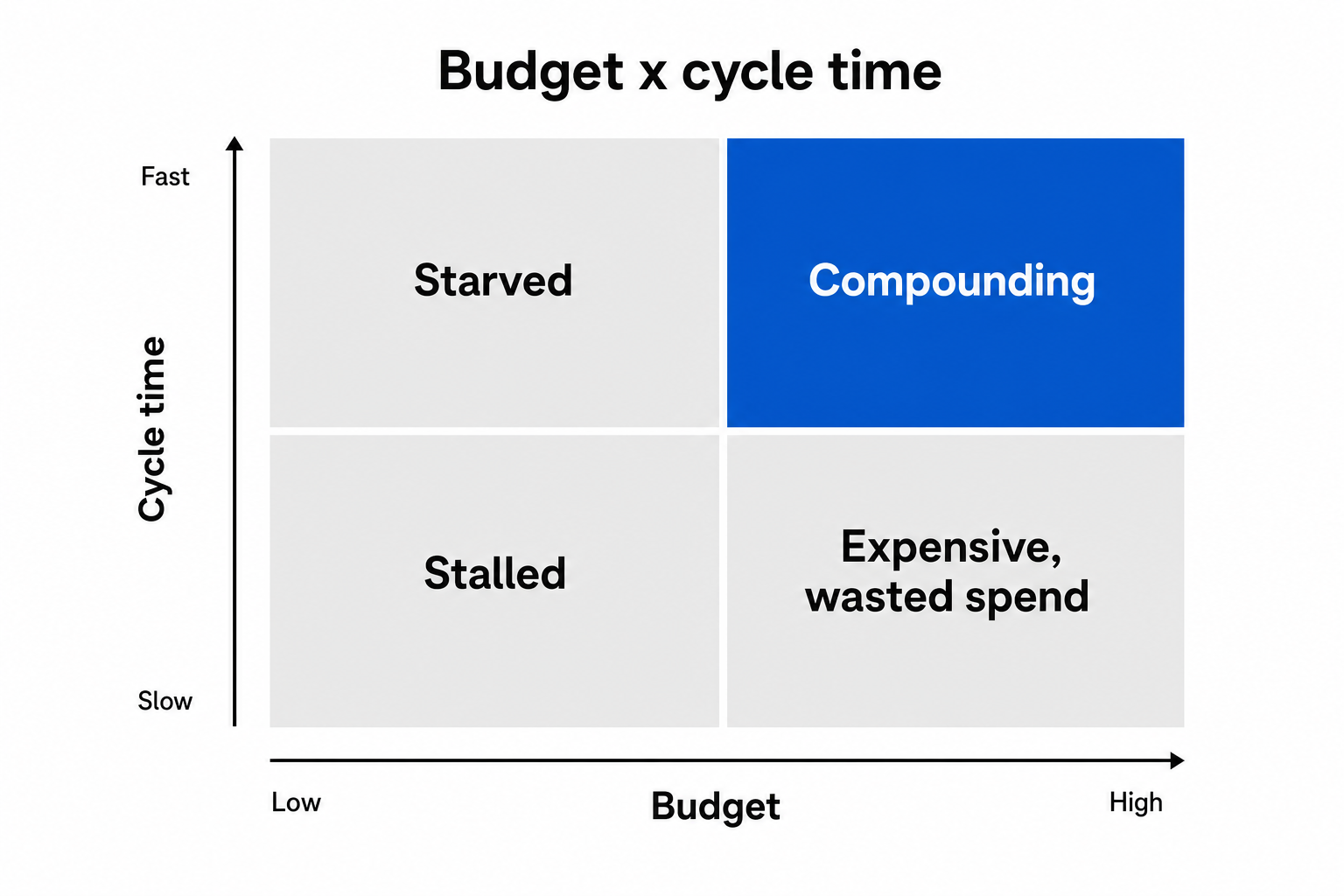
They are complements. The right model is budget × cycle time. A big budget compounds a fast loop, and a slow loop wastes a big budget. Multiply a large number by a small one and you still get a small result.
Here is the observation we keep running into. When we open a well-funded account, the binding constraint is rarely the budget line. It is the number of days between deciding to change something and that change being live. Compress that number and the same budget produces more winners, because you get more quality shots and read each one sooner.
The returns math makes this concrete. Even strong teams see only about two of every ten experiments move the metric that matters. Optimizely's analysis of 127,000 experiments found roughly 12% deliver a statistically significant improvement on the primary metric, across digital experiments in many industries rather than B2B SaaS paid specifically.
When most tests fail, your return is set by how many quality shots you take and how fast you learn from each. Cycle time governs both.
What faster actually looks like
A tight loop starts with diagnosis before it touches spend. Read the conversion signal first and confirm you are counting qualified pipeline rather than a proxy. Then make the obvious fixes fast: negatives, search-term mismatches, weak ad copy, and landing pages that fight the ad.
From there, rebuild the highest-impact campaigns around real buyer intent. After that, iterate weekly on search-term quality and on lead-quality feedback from sales.
The reason this is possible now is that the slow parts of iteration have collapsed in time. Research, platform operations, creative production, and landing-page changes used to sit in separate queues owned by separate people. AI compresses each of those steps, so one accountable operator, AI-enabled and embedded, can close the loop in hours instead of weeks.
Judgment stays human. A person still decides what to test and when a pattern is real rather than noise. The machine handles execution and speed. The operator owns the calls that carry consequences. Smaller and faster out-iterates bigger and slower.
Teams that have built and run paid at scale treat cycle time this way. The people who helped build the LinkedIn Ads platform and have run paid for Reddit, Gusto, Warp, and Linear reach for velocity before headcount. The lever is the distance between a decision and a live change.
The honest tradeoffs
Faster iteration means more visible losses. If most experiments fail, a fast loop surfaces those failures quickly and in the open. That is the cost of finding the two in ten that work, and it can feel worse before it feels better.
Speed also has a floor. Some things genuinely need a full conversion cycle to read, and churning bids daily is noise rather than velocity. The platform needs time to learn between changes, which is why Google advises you to minimize fluctuations while the bid strategy adjusts. Most practitioners go a step further and hold targets steady across a single conversion cycle. Faster means removing delay from the human steps, not overriding the math the platform needs.
Fragmentation is the specific temptation new money brings. More budget invites more campaigns, and more campaigns split your conversions below the learning threshold. Consolidating down to fewer, better-funded campaigns is often the faster path to signal.
One more point on scope. This is about paid media on Google and LinkedIn, which is one slice of demand generation. It is not your whole funnel or your sales motion. The frame holds inside that slice.
FAQ
We just raised. Should we increase paid budget right away?
Increase it in step with your loop. If you can diagnose, change, and read results in days, more budget compounds. If changes take weeks, raise spend gradually and fix cycle time first, or the extra money funds untested bets.
How much of a raise should go to paid media?
There is no universal split, and benchmarks vary by segment and funding type. Median marketing spend sits near 8% of ARR for private B2B SaaS. Start from your payback tolerance and your loop speed, not from a percentage someone else runs.
Why is our cost per acquisition rising even though we're spending more?
Usually because spend is outrunning iteration. Extra budget buys more volume against the same untested campaigns, and often more low-intent conversions. Rising CAC on rising spend is common right now: the median CAC ratio hit $2.00 in 2024. Faster correction is the fix.
What is cycle time in paid media, and how do we measure it?
Cycle time is the number of days between deciding to change something and that change running live. Measure it by timestamping a few real changes: decision date to launch date. Count the waiting, the approvals, and the handoffs, not just the work.
How many experiments should we expect to work?
Plan for roughly two in ten to move your primary metric. Optimizely's analysis of 127,000 experiments put statistically significant wins near 12%, across digital experiments broadly. Your total wins depend on how many quality shots you take and how quickly you read each result.
Does more budget help Google's algorithm learn faster?
Up to a point, yes. Bidding needs volume, and Google suggests at least 30 conversions to measure Smart Bidding (50 for Target ROAS). Past that threshold, more budget mostly adds volume. Frequent, batched target changes reset learning and slow it back down.
The teams that win the year after a raise
A raise gives you room to spend. The returns come from pairing that room with a loop that turns spend into learning fast. Budget and cycle time multiply, so the money compounds only where both are high.
The teams that win the year after a raise are the ones that shorten the distance between a decision and a live change. That is an organizational problem more than a financial one, and it is fixable without waiting for the next round.
This is the work we do. We run paid media end to end on Google and LinkedIn through Thunder Agent OS, with one accountable operator, AI-enabled and embedded, owning the loop and the outcomes. Our fee is decoupled from your media spend, so scaling budget does not scale what you pay us to manage it.
If it helps, we can send a short teardown of where budget is outrunning cycle time in your account.